
Senior Capstone: Urban Wind Turbine
Ongoing Project: Fall 2025 – Spring 2026
Developed and tested custom wind measurement systems and vertical-axis turbine prototypes to evaluate and optimize small urban wind turbines for amplified wind conditions on Boston University’s campus.
Project Overview:
This senior capstone project evaluates the feasibility of installing a small urban wind turbine on Boston University’s campus by measuring and analyzing wind patterns created by campus architecture. Using custom-built wind measurement systems and turbine prototypes, we identified consistently amplified wind speeds and developed horizontal- and vertical-axis turbine designs optimized for real-world urban conditions.
My primary contributions included WIMSY manufacturing and monitoring, and VAWT design, manufacturing, and testing.
Theoretical Model & Data Analysis:
To begin, custom wind measurement systems (WIMSYs) were built to track wind speed and direction. Each WIMSY contained an Arduino Uno, DS1307 real-time clock, anemometer, wind vane, and SD card data logging. Devices were powered with 8 D-cell batteries via a buck converter to ensure a stable voltage.
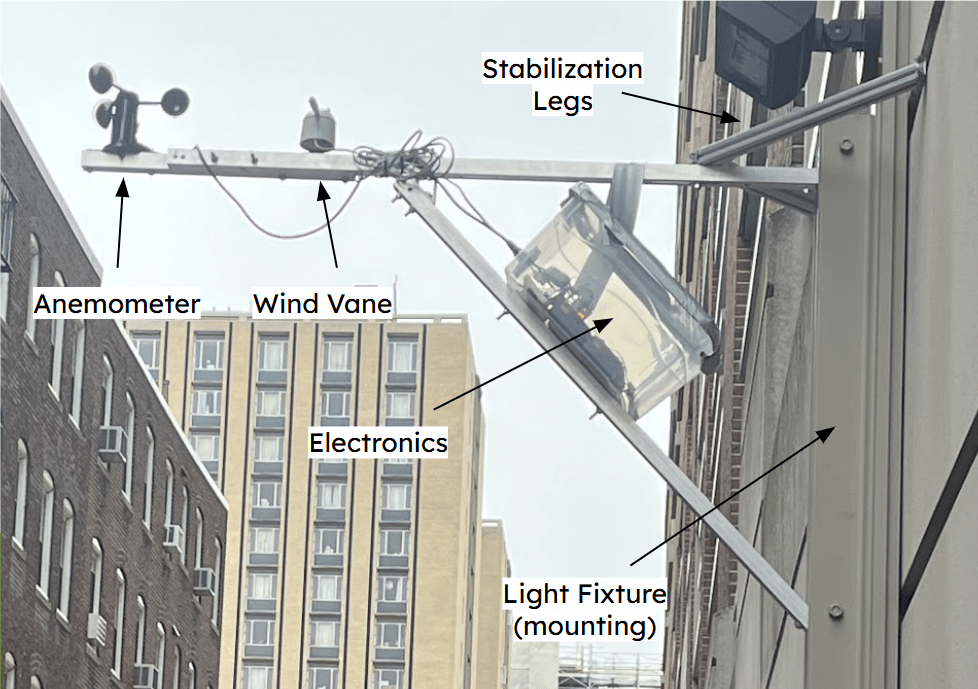
Two testing sites were chosen. One in the Photonics alleyway near the Photonics building on BU’s campus. The other is on the 5th-floor balcony of the Center for Computing and Data Sciences (CDS) building on campus. The WIMSY has been deployed in the Photonics alleyway and will soon be deployed on the CDS balcony.
After deployment in the Photonics alleyway, data was collected over 12 days and compared with readings from a rooftop weather station at a nearby building (CAS building) on campus. Analysis revealed:
- Wind speeds were 27% faster in the alleyway than at the CAS station.
- Wind direction was consistently from the west, parallel to the alley.
- Wind speeds were more consistent than at the CAS station, which allows for more design flexibility.

Using this data, we calculated a wind amplification factor, which informed the geometry and expected performance of our turbine prototypes.
Prototype Design & Modeling:
These measurements showed that the alleyway has faster and more predictable wind than standard campus locations, allowing the turbine to be designed around a narrow range of operating conditions. This informed the development of two prototype designs—a horizontal-axis and a vertical-axis wind turbine—each evaluated for performance under the measured wind conditions.


Horizontal-Axis Wind Turbine (HAWT):
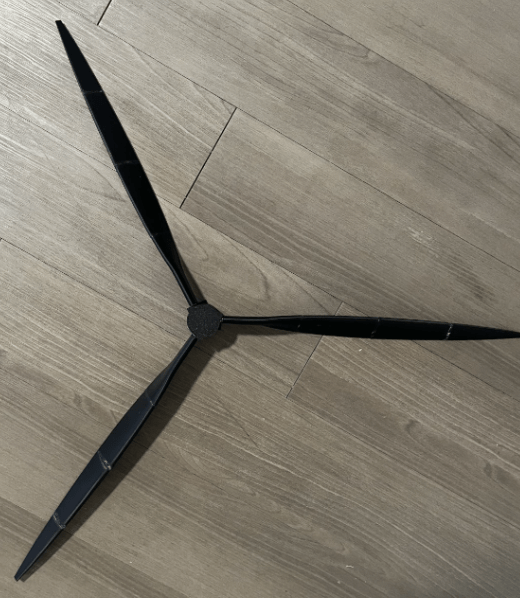
The horizontal-axis wind turbine was designed using established wind turbine principles, with blades connected directly to a central hub driving the generator. Measured wind speeds from the Photonics alleyway were used as inputs to the blade design process.
Blade geometry was optimized using X Rotor for the expected operating wind speed. The final design used a blade radius of 40 mm, resulting in a swept area of approximately 0.5 m². Initial testing at the expected wind speed produced approximately 100 mW of power, demonstrating proof-of-concept performance.
Vertical-Axis Wind Turbine (VAWT):
The vertical-axis wind turbine was designed to better accommodate space constraints and potential wind direction variability. A lift-type (Darrieus) turbine with helical blades was selected to reduce torque ripple and provide smoother rotation.
The blades were 3D printed in PLA, with laser-cut MDF used for the main supports. The central shaft was fixed, and the blades rotated around it, driving a DC motor through a geared connection. A full CAD model was created to validate geometry and assembly prior to fabrication, and the prototype was successfully manufactured.
Next Steps
- Deploy the second WIMSY on the CDS 5th-floor balcony and collect wind data over two weeks
- Install both turbine prototypes in the Photonics alleyway to measure and compare real-world power generation
- Select a final turbine configuration based on wind data from both locations and prototype performance
- Design, manufacture, and evaluate an optimized turbine prototype under real-world conditions
Key Skills Developed
Technical Skills:
- Arduino-based instrumentation and long-term data logging
- Wind measurement system design and sensor integration (anemometer, wind vane, RTC)
- Wind data analysis and amplification factor evaluation
- CAD modeling for turbine and system design
- Design and fabrication of horizontal- and vertical-axis wind turbine prototypes
- Prototype testing and performance evaluation under real-world conditions
Professional Skills:
- Team-based engineering design and technical collaboration
- Data-driven decision making for design optimization
- Systems-level thinking across measurement, modeling, and prototyping
- Experimental planning and field deployment in outdoor environments
- Technical documentation and presentation of engineering results
 Sofia Luce Portfolio